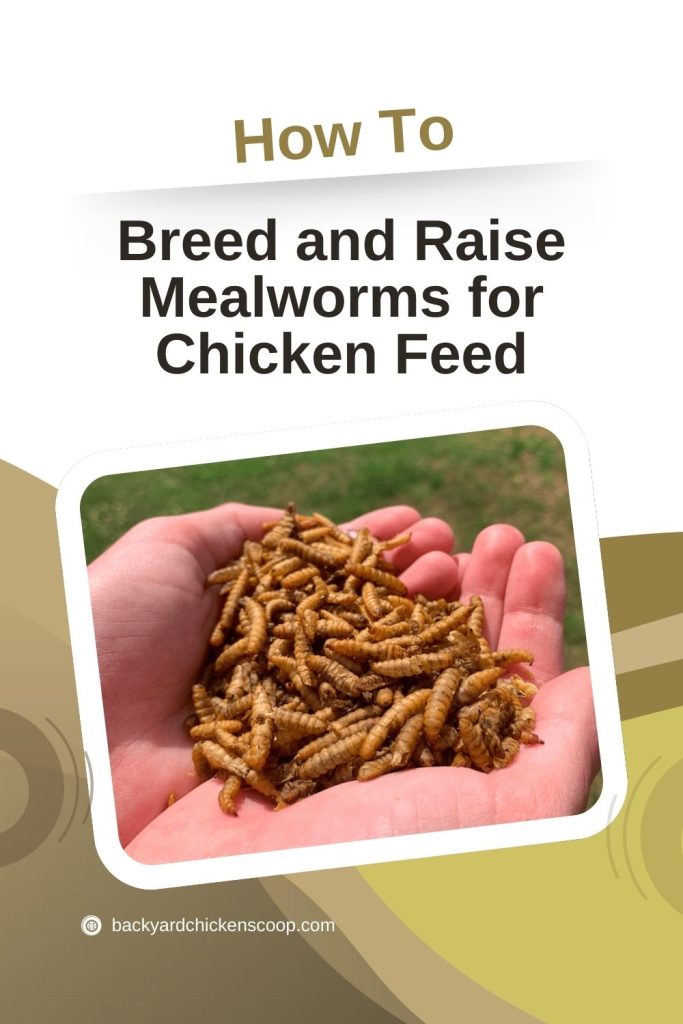
Have you ever considered raising mealworms for chicken feed? While most people see mealworms as pesky insects that ruin food supplies like flour or grains, chicken owners know better. These little critters may be squirmy, but they are a protein-packed treat that chickens absolutely love.
From a human perspective,
Raising

Why Grow Mealworms ?
You can buy
Starting a mealworm colony is simple, affordable, and even fun. After a small initial investment, maintaining a colony costs almost nothing.
If you have kids, this can be a great project for them. Raising

How Long Does It Take To Raise Mealworms ?
Depending on several factors, the time you’ll need to farm the
This process may take about 8 – 10 weeks on average during the summer. However, when temperatures are lower in winter, it may take up to 5 months.
The number of
What Are The Stages Of The Mealworm Life Cycle?
To get a better idea about how fast you can raise mealworms, you should first understand their life cycle.
Darkling Beetles mate, and one female beetle can produce up to 500 eggs over 1-5 months. The more humid the environment, the more eggs it will produce. The eggs are white, tiny, and shaped like a bean. The egg will hatch into a larva after 1-2 weeks (12 days on average).
The larva or mealworm is initially very small and whitish. It takes around 3 months to fully grow, but this period can vary depending on available food, humidity, and temperature. During this time, they will go through several molts or skeleton shedding.
This can happen up to 20 times. As they grow older, the
In the pupa stage, the
The final stage of the mealworm life cycle is hatching from a pupa to a beetle. At first, beetles are weak and have lighter colors, sometimes even white. As they mature, beetles will grow stronger, and their color will turn darker before finally becoming black and shiny. The maturing process lasts only a couple of days. After that, the Darkling Beetles are fully grown and live for a few months.

Setting Up Your Mealworm Farm: What Equipment and Containers Work Best
Before you go shopping, you should decide whether you want to start your farm in a single container or use a multi-tiered system. Both systems have advantages and disadvantages.
Keeping your
On the other hand, separating
It also requires more space and more effort. I wouldn’t recommend this system to beginners. If you’re going with a single container, you’ll need the following materials and supplies:
- Plastic container with smooth sides or glass aquarium
- Grain for bedding – you can use wheat bran, plain oatmeal, or cornmeal
- Slices of
carrot or potato - Mesh (if you don’t want to use the container’s lid)
- Paper towels, old newspaper, or scrapped cardboard
- Bucket sifter
- Mealworms (of course 😉 )
Also, make sure that you have the following tools handy:
- Drill (with drill bit)
- Duct tape
- Scissors
If you choose the multi-tiered option, prepare the following materials and supplies:
- Set of drawers
- Window screen or hardware cloth
- Mesh
- Grain for bedding – you can use wheat bran, plain oatmeal, or cornmeal
- Slices of
carrot or potato - Paper towels, old newspaper, or scrapped cardboard
- Bucket sifter
- Mealworms
The tools you’ll need with this system are pretty much the same as when using a single container.
What Kind Of Bedding Do You Use For Mealworms ?
The bedding or substrate that the
If possible, try to use organic food for your mealworm farm bedding. Be aware that
Wheat bran and oatmeal have the perfect structure for
Before placing the
If you skip this step, you might end up with what I had at one time: The sites may swarm your farm and provide competition for food to your
You should also add some old newspaper, scrapped cardboard, or paper towels on top of the bedding. The
Your colony should have a certain level of moisture. Mealworms can’t drink water. They get the necessary moisture by eating pieces of fruit or vegetables.
Adding potato or
Once you set the bedding, you’ll probably be good for 3 or 4 months. After that, you’ll need to remove it and replace it with a fresh substrate. When doing this, use the bucket sifter to separate the
The leftover frass can be a great fertilizer for your garden.
What Do Mealworms Eat?
The
Wheat bran is the most popular substrate choice. You’ll most likely find it in the nearby feed store, where it is mostly in 50-pound bags. Besides its nutritious value, wheat bran is a good choice because it doesn’t compact, thus providing larvae and beetles with enough space to move freely. It’s also very convenient when it comes to harvesting and separating
Another common option is oatmeal. When buying oatmeal for colony bedding, make sure it’s plain. Avoid those with specific flavors. Any rolled oats will do. Feel free to use instant oats or Quick Cook oatmeal.
The only type to avoid is steel-cut oats, as

How Often Do Mealworms Need To Be Fed?
There’s no particular rule on how often you need to feed your
In general, keep track of how your substrate looks. When the grain particles start to look smaller and the bedding gets thinner, it’s time to add some more food.
In addition, remember to regularly add vegetable or fruit slices so your
What Temperature Should Mealworms Be Kept At?
The conditions in which you keep your
So, for your
The ideal temperature for raising
At colder temperatures, the larvae stage may take up to two years. Longer exposure to the extreme cold will kill them. Too high of a temperature is not good either. Keeping them in an environment that is too warm also impacts their growth.
Especially if paired with low humidity.The pupal phase will last 6 days at 91 °F (33 °C), 7 days at 80 °F (27 °C), 10 days at 75 °F (24 °C), and 13 days at 70 °F (21 °C). If you live in a colder climate, you may need to use heaters to keep your colony warm enough. If you’re doing this, add plenty of vegetable or fruit slices to keep the humidity high enough.
| Temperature (°F) | Temperature (°C) | Pupal Phase Duration (Days) |
|---|---|---|
| 91 | 33 | 6 |
| 80 | 27 | 7 |
| 75 | 24 | 10 |
| 70 | 21 | 13 |
How To Farm Mealworms for Free Chicken Feed

Step 1: Getting A Container
Before starting your mealworm colony, you’ll need to determine what kind of container you want to use and find it. You can use a single container or a multi-tier system with a shelf containing several drawers.
There are several suitable alternatives if you’re going for a single container. Each of them costs very little or nothing. The options include an old aquarium or any glass box, a plastic storage container, or a recycled trash bin.
Aquariums and glass containers are perhaps the most fun options, especially for kids, as they can see what’s going on inside.
The container must be solid and smooth inside (so the
You will also need the lid for your container. It will keep the
You can use the 1/8-inch drill bit. Alternatively, you can cover the container with a mesh or window screen. Ideally, the container should be 12 inches wide, 24 inches long, and 12 inches deep. Of course, if you can’t find this exact size, any container of similar proportions will do.
If you opt for the multi-tier system, you’ll need a shelf with at least three drawers. The point of this farming system is to keep your
The top bin holding beetles should look a bit different from the others. You’ll need to cut out the bottom of the drawer and replace it with a window screen or mesh. This will ensure that the freshly laid eggs won’t get eaten.
Instead, they will fall through the bottom to the middle drawer. If you want, you can add extra mealworm drawers. Doing this will enable you to rotate mealworm trays so that those in the same tray are about the same age. This container system will require more work than a single bin.
You’ll have to hand separate new pupae for the middle drawer and move them to the bottom drawer so the
Step 2: Preparing The Container
Once you select the container you want to use, thoroughly clean and dry it. This is especially important for starting your farm in a used container like an old aquarium.
Next up, you have to choose the location for the container.
Low temperatures can be an issue for those living in areas with cold winters. You can deal with this by purchasing a heat mat for keeping reptiles or similar pets. They’re very easy to install, come pre-wired, and commonly have programmable thermostats.
Step 3: Adding The Substrate
When you finish setting up the container, the next step is to provide food for your mealworm colony. You’ll need to fill the container with the substrate about three inches deep. You can use wheat bran, oatmeal, chicken mesh, or cereal crumbs for substrate or bedding.
Remember that
Before adding substrate to the container, you must disinfect it and ensure that it doesn’t contain pests such as grain mites. To do this, you can microwave it for about a minute or freeze it for three days.
As
Finally, you should insert some pieces of old paper or cardboard.
Step 4: Adding Mealworms To Your Farm
While your ultimate goal is to create a self-sustainable farm that can reproduce itself without cost, you must purchase the initial batch of
You can purchase them at specialized feed stores or online. Ask around before buying to make sure you get top-quality
In any case, make sure that you buy them from a trusted source. If possible, try to find out what the
Many people make the mistake of buying gigantic worms, thinking that they will provide more food for the chickens. However, avoiding this would be best, as those
When you finally acquire your first batch of
Step 5: Maintaining Your Mealworm Colony
Once you see the colony, all left is to feed your
Also, occasionally, add a couple of new bits of vegetables or fruit. In addition, keep an eye on the state of the container so you can notice potential issues such as mold.
Step 6: Harvesting The Mealworms
In 3 or 4 months, your farm will be ready for harvesting. You can harvest
You can pick

Mealworm Long-Term Storage: Live and Dead
Sometimes, you’ll have plenty of full-grown
To keep the mealworm in this life cycle stage, you’ll need to place them in the refrigerator at (45 – 50 °F ). At low temperatures,
They can stay in the refrigerator even for a couple of months. It is recommended that you take them out for a day and leave them on the prepared bedding at room temperature once a week. This will further prolong the time they can spend in the refrigerator.
Another storage option is drying your
Frequently Asked Questions
How Do You Get Rid of Mealworms ?
In some situations, you may want to kill your
For example, if the colony has become infested, you can easily remove it by pouring boiling water over it or simply leaving it outside and letting the wild birds take care of it.
Do You Need to Kill Mealworms Before Feeding to Chickens?
You can freely feed live
What do mealworms drink?
Mealworms get all the moisture they need from the slices of vegetables or fruit you add to their substrate.
Do mealworms bite?
Mealworms are capable of biting, and they have mandibles. However, they’re so small that there’s no way that they can harm you.
Can you touch mealworms ?
You can safely handle
Do mealworms have feelings?
Like all animals with simple nervous systems,
Are black mealworms dead?
Mealworm or Pupae turning black is usually a sign that they’re dead. The most likely reason is the lack of moisture at the end of the larval phase.
Why are my mealworms turning into beetles?
Mealworms turning into beetles is a normal part of their life cycle, which has four stages: egg, larva (or mealworm), pupa, and beetle.
Do mealworms eat coffee grounds?
You can add coffee grounds to the mealworm diet. However, as they’re fine-ground, you should add only small quantities and not make the substrate solely of the coffee grounds.
Do all mealworms turn into beetles?
Eventually, all healthy
Do mealworm beetles fly?
Darkling Beetles, who